
The 3 Routes to Free Travel: Which One Fits Your Life Right Now?
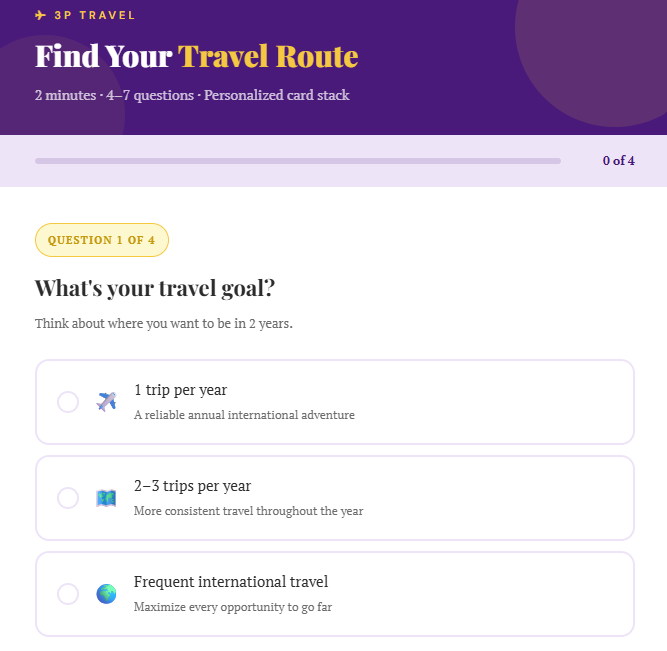
I want to tell you something nobody else in the points world says out loud: the right credit card strategy depends on your personality as much as your spending.
Most travel hackers will hand you a list of 10 cards and tell you to get started. And maybe that works for some people. But I have watched that approach stop busy professionals in their tracks because it feels like homework, not freedom.
So when I built 3P Travel, I built three routes to the same destination. Same cards. Same points currencies. Same transfers. Just different speeds.
Here is how to figure out which one is yours.
The Scenic Route: One card every 4 to 6 months, over 24 months
If you want to start learning the system without turning it into a second job, this is your lane. You open five cards over two years, the same five cards as every other route, and by the end you have a fully functional travel rewards engine. You will take one to two international trips over that window and you will never feel rushed or overwhelmed.
The Scenic Route is not the slow route. It is the sustainable route.
The Express Route: Five cards in 12 months, recommended for most people
This is the 3P Travel default. One new card every two to three months, starting with the Chase Sapphire Preferred in month one. You build the Chase Ultimate Rewards foundation first, add a no-fee catch-all card, open an Ink Business card if you have any self-employment income (more on that below), then round out with the Capital One Venture X for lounge access and the Amex Gold for dining and grocery power.
By month 12, you have five cards, three points currencies, and enough welcome bonus points to take two to four international trips in year two.
The First Class Route: Ten cards in 12 months, one every 45 to 60 days
This one is not for everyone. But if you are motivated, organized, and ready to build a full travel system fast, this is how you get to four or more international trips in year one with premium cabin access built in. This is how we earned over one million points in a year.
The first five cards are identical to Express. Card six adds Capital One Venture X. Cards seven and eight are personalized: you choose your primary airline and your preferred hotel chain, and the system matches you to the right co-brand card. Cards nine and ten are your accelerator layer, either Amex Platinum plus Chase Freedom Flex (personal income) or Amex Business Platinum plus Ink Business Cash (business income).
Year one welcome bonuses on this route run between 600,000 and 975,000 points and miles across four currencies.
A note on business income
Every route references business cards, and people always pause here. You do not need a registered LLC. You do not need a storefront. Any self-employment income counts: freelance work, tutoring, selling items online, consulting, a side project you are paid for. If you have any of that, you likely qualify for Ink Business cards, and those cards do not count against your Chase 5/24 limit.
How to choose
Ask yourself one question: When I imagine adding a new credit card to my wallet, does that feel exciting or stressful?
If exciting: Express or First Class.
If stressful: Scenic Route, and start with just the Chase Sapphire Preferred.
The goal is not to collect cards. The goal is to get your family to places they would not otherwise go. The route is just the vehicle.
Swipe smart. Go far. ✈️
Cassie Jemilo
3P Travel ✈️
Subscribe HERE for a free 3P Travel course, resource guide, and weekly tips to earn free travel.
Ready to build your points balance? Start with the free intro class at 3p-travel.com. No experience required.
